
Chemistry, geology, minerals, oil, fossils, medicines, cosmetics. At first, it may sound like a bunch of unrelated topics. But that is exactly what trips like this are about. Showing young people that science is not something locked inside a textbook, but that everything is connected. And that what we learn at school later appears in toothpaste, creams, medicines, construction, industry, fuels or even in an ordinary stone.
This time, we went with the students to VŠB – Technical University of Ostrava. The programme was divided into two smaller groups so that the students could really try more things themselves and would not just be spectators somewhere in the back row. And that, for me, is essential. Because once you take a test tube in your hand, mix something, watch a reaction and see the result, chemistry suddenly stops being “something for a test”.
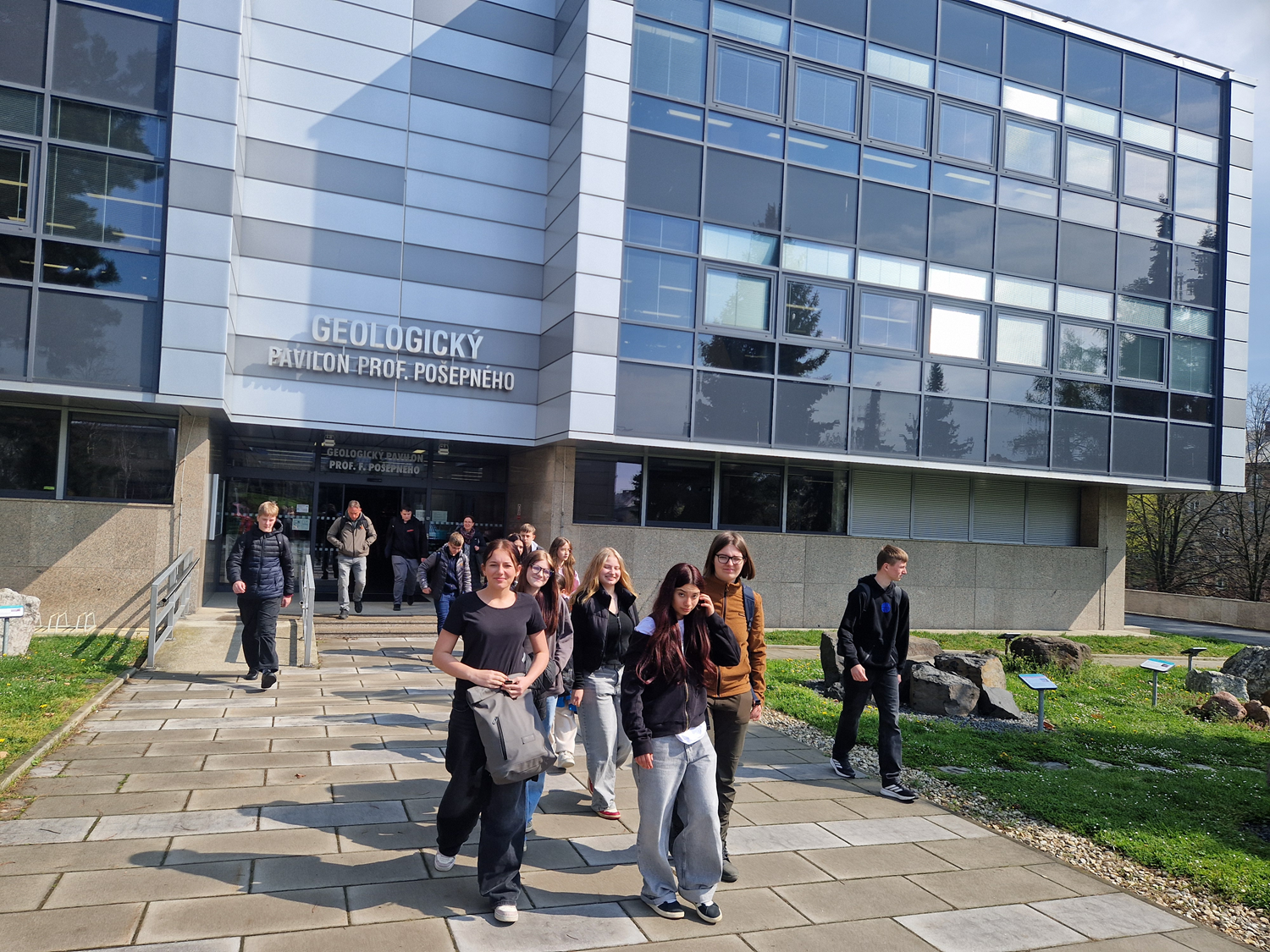
The excursion began in the Geological Pavilion of Prof. František Pošepný and continued in the laboratories of the Centre for Energy and Environmental Technologies at VŠB-TUO.
Source: GreenScan
Geological Pavilion: Minerals, Fossils, Oil and Gemstones
The first part of the programme took place in the Geological Pavilion of Prof. František Pošepný at VŠB – Technical University of Ostrava. The students attended an introductory lecture by VŠB staff, followed by a guided tour of the exhibition.
And this is where a completely different world opened up. Minerals, rocks, fossils, semi-precious stones, gemstones and oil products. Not just display cases and “pretty stones”, but a story about how the planet was formed, where the raw materials around us come from and why rocks and minerals are important not only for geologists.
For me, this part was close to my heart, because I have loved stones since childhood. Fossils, interesting stones, crystals, smoky quartz, amethysts or fluorites are things I can search for in fields, forests and quarries. And that is exactly why it makes sense to me to show geology to young people. Once you understand that a “stone” is not just a stone, you start to see the world around you differently.
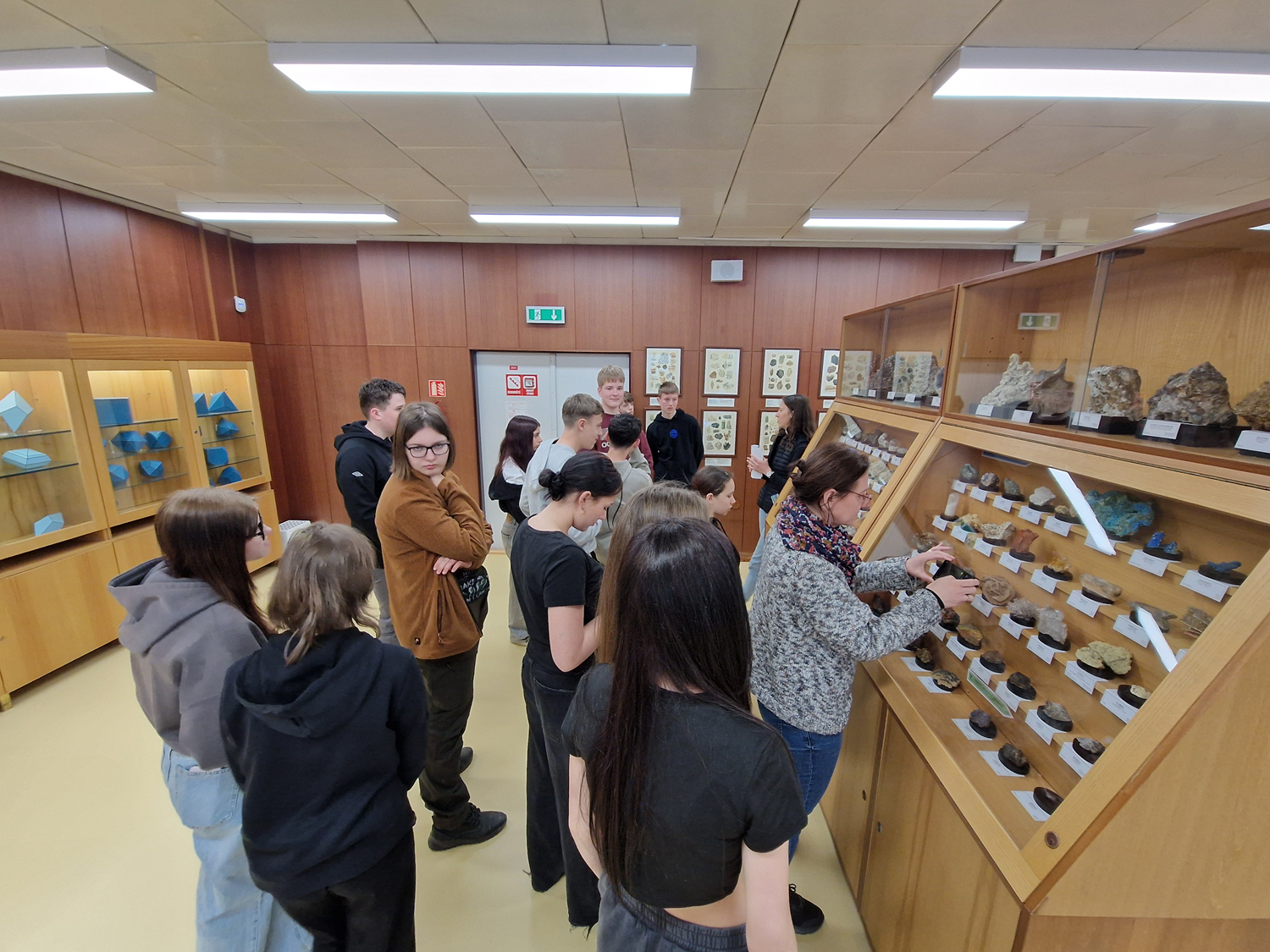
During the tour, we talked about how minerals are formed, what their importance is in industry and where we encounter them in everyday life. Some examples connected beautifully with cosmetics, medicines and everyday hygiene.
Fluorite, also known as fluorspar, is connected to fluorine and fluorides. And most people know fluorides mainly from toothpastes. So from a mineral in a display case, we suddenly got all the way to brushing our teeth in the morning.
Source: GreenScan
Many people associate calcium mainly with bones and teeth, but its compounds are also found in rocks, food supplements, some medicines and cosmetics. Calcium carbonate, for example, can be used as a filler, a mild abrasive ingredient in some toothpastes, or a substance that adjusts the properties of a product.
Gypsum is another great example. It is used to make plaster, which we know from construction, healthcare and dentistry. A mineral that may not look very dramatic at first glance has enormous practical use.
And oil? It may not be as photogenic as amethyst or rock crystal, but our world is still strongly connected to it. Oil is not used only to make fuels. Oil products are also linked to the production of plastics, synthetic materials, paraffin, petroleum jelly, mineral oils and other substances that can be found in some cosmetic or pharmaceutical products.
And this is exactly where questions we deal with in GreenGate open up beautifully. Where do substances come from? Why do we use them? When are they useful? When are they unnecessary? And what happens to them after we use a product?
Fossils, the Beginning of Life and Dinosaurs
The part dedicated to fossils and the evolution of life also attracted a lot of interest. The students were interested in the screen showing the beginning of life and, of course, in the exhibits connected with the ancient history of our planet. Unfortunately, we did not have as much time for this part as we would have liked.
One piece of feedback said it all:
“Dinosaurs, sand and the experiments were fun.”
The Geological Part Ended with an AZ Quiz
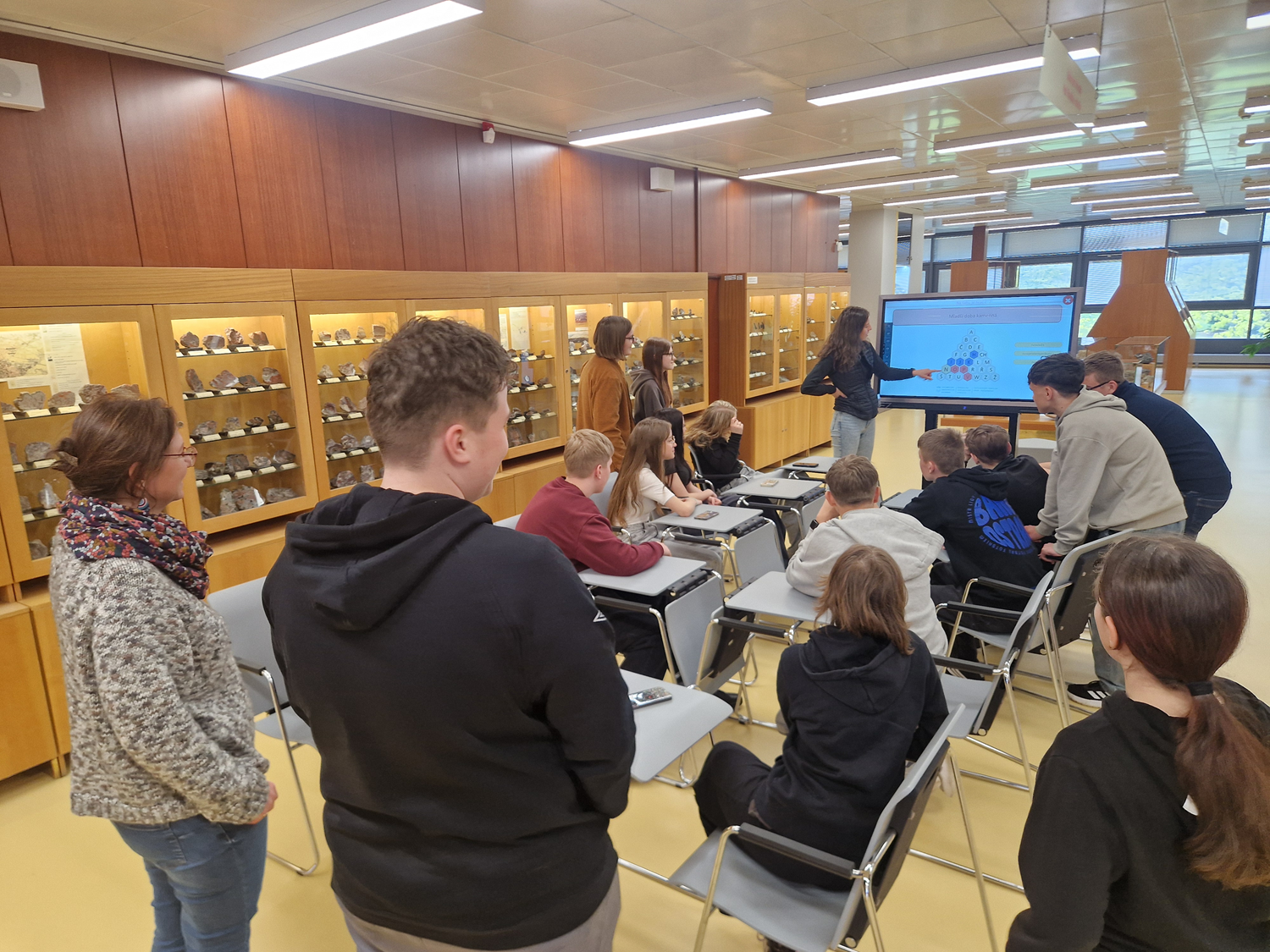
At the end of the geological excursion, there was an AZ quiz. And this is where a pleasant surprise came.
Source: GreenScan
The students had the option to sit, rest, look at their phones… But instead, they chose a knowledge quiz. They wanted to play, answer questions, compete and show what they knew.
That was a really nice surprise. People often say that young people are not interested in anything. But here we saw something completely different. When a topic is presented in a practical, understandable and slightly playful way, students get involved. They want to know. They want to try. And they really had an overview 👏.
CEET Laboratories: Chemistry That Really Happens
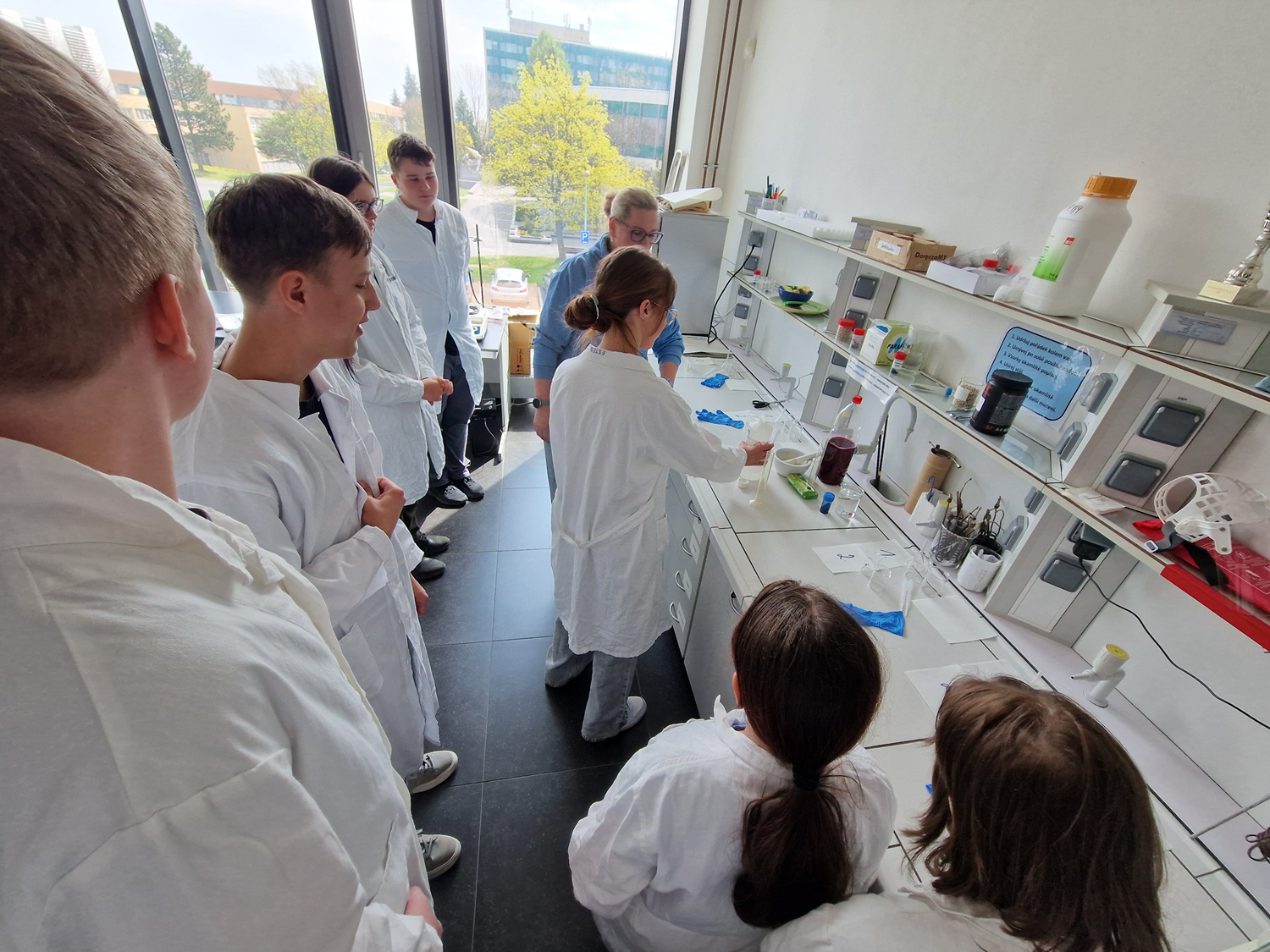
After the geological part, the students moved to the laboratories of the Centre for Energy and Environmental Technologies at VŠB-TUO. The programme was practical, clear and, most importantly, involved the students themselves.
In the laboratories, they tried several experiments. For example, the decomposition of hydrogen peroxide, where it was beautifully visible that a chemical reaction does not have to be just an equation on the board. It can be fast, visible and much more memorable for students.
Another experiment was the adsorption of dyes using activated charcoal. This is a great example of a substance we also know from everyday life. Activated charcoal is used as a medicinal product for some digestive problems, for example when we eat something that does not agree with us. It can also be found in some toothpastes or face masks. In the laboratory, the students could see a principle that also appears in products they may commonly encounter.
They also worked with natural substances, for example isolating chlorophyll from leaves and beta-carotene from carrots. Chlorophyll as the green pigment in plants, beta-carotene as the orange pigment known from carrots. Here, chemistry connected beautifully with food, cosmetics, food supplements and the topic of colourants.
There was also denaturation of proteins using egg white. This is something we know from the kitchen, but we do not usually think of it as chemistry. Yet chemistry is also cooking, baking, cleaning, cosmetics, digestion and the production of medicines.
Source: GreenScan
Experiments Were the Biggest Hit
The feedback clearly showed that the laboratory part was something the students really enjoyed. Some answers were short, but all the more telling.
“Experiments in the chemistry laboratory, because it was fun.”
“I liked the laboratory the most.”
“The experiments in the laboratory. I enjoy doing experiments.”
“I liked the chemistry experiments because they were interesting.”
“Nice staff, experiments in the laboratory.”
“Lab.”
Why It All Makes Sense
We were also very happy with the teachers’ reaction. They were excited about the excursion and we are already talking about further cooperation and more groups of students. And if GreenGate helps create a direct connection between the school and VŠB, where teachers will be able to take students on more excursions on their own, then that is a great impact of the project.
The goal is not to turn everyone into chemists, geologists or researchers. The goal is to show that science is not boring, chemistry is not something to be afraid of, and geology is not just stones in a display case. Cosmetics, medicines, toothpaste, oil, minerals, activated charcoal, fossils and the environment are much more connected than it may seem at first glance.
The students took away new knowledge, practical experience and a real experience. And when students come back from an excursion saying they enjoyed the experiments, minerals, dinosaurs, the AZ quiz and the lab, then for us it did exactly what it was supposed to do.
The laboratory part was also covered by CEET in the article “Young Chemists in Action: Students from Albrechtice Experimented in CEET Laboratories”. The school’s view of the event can be found in the article “To VŠB for Science: Class 8.B Tried the Role of Researchers”.
0 Comments